
The Arrest and Assassination of Patrice Lumumba: A Defining Tragedy in African History

Introduction
Patrice Lumumba, the first democratically elected Prime Minister of the Democratic Republic of the Congo, remains one of the most influential figures in African history. A passionate advocate for Congolese independence, economic self-determination, and Pan-African unity, Lumumba became a symbol of resistance against colonial influence. However, his vision for an independent Congo brought him into conflict with both domestic rivals and foreign powers. On January 17, 1961, Lumumba was brutally executed in an event that continues to shape discussions about colonialism, foreign intervention, and political sovereignty in Africa.
The Political Crisis and Arrest of Lumumba
Following Congo's independence from Belgium on June 30, 1960, the country quickly descended into political instability. A military mutiny, regional secessionist movements, and tensions within the government created a crisis that threatened the young nation.
In September 1960, President Joseph Kasa-Vubu dismissed Lumumba from office amid growing political disagreements. Shortly afterward, Colonel Joseph-Désiré Mobutu, who later became President Mobutu Sese Seko, seized power through a military coup and placed Lumumba under house arrest.
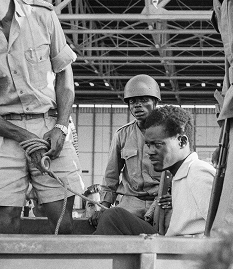
Determined to continue his political struggle, Lumumba attempted to escape in late November 1960 and travel to Stanleyville (present-day Kisangani), where he enjoyed significant political support and intended to establish a rival government. However, he was intercepted and arrested by Mobutu's forces on December 2, 1960.
After his capture, Lumumba was subjected to severe mistreatment. He was beaten, illegally detained, and eventually transferred to Elisabethville (now Lubumbashi), the capital of the secessionist province of Katanga. The province's leadership was strongly opposed to Lumumba and supported by Belgian interests.
The Execution of Patrice Lumumba
On January 17, 1961, Lumumba arrived in Katanga alongside two of his closest political associates, Maurice Mpolo and Joseph Okito. Upon arrival, the three men were subjected to torture and humiliation by their captors.
Later that evening, they were transported to a remote forest area where they were executed by a firing squad. Historical investigations have established that Belgian officers were present and played a significant role in overseeing the execution. The killings were carried out with the cooperation of Katangan authorities and occurred amid broader international efforts to eliminate Lumumba as a political force.
The Cover-Up
Following the execution, Katangan authorities concealed the truth about Lumumba's death. For nearly a month, the public was misled with false claims that he had been killed by angry villagers after escaping custody.
To prevent Lumumba's grave from becoming a site of remembrance and political resistance, Belgian officers later exhumed the bodies of Lumumba, Mpolo, and Okito. The remains were dismembered and dissolved in sulfuric acid in an effort to erase all physical evidence of the crime. This deliberate destruction of the bodies became one of the most notorious cover-ups in modern African history.
International Involvement and Responsibility
Subsequent investigations and declassified documents revealed that foreign governments viewed Lumumba as a threat to their political and economic interests in Central Africa. During the height of the Cold War, Western powers feared that Lumumba's policies and his willingness to seek assistance from the Soviet Union could undermine their influence in the region.
Evidence has shown that elements within the Belgian government and the United States Central Intelligence Agency (CIA) were involved, directly or indirectly, in efforts to remove Lumumba from power. Although the extent of each actor's participation remains debated among historians, there is broad agreement that foreign intervention contributed significantly to the circumstances that led to his assassination.
Historical Accountability
Decades after Lumumba's death, efforts to establish accountability gained momentum. In 2002, the Belgian government formally apologized to Lumumba's family and acknowledged its "moral responsibility" for the events surrounding his assassination.
Legal proceedings have also sought to hold surviving officials accountable. In a landmark development, a Brussels court authorized legal action against former Belgian officials, including Étienne Davignon, over allegations that they helped orchestrate Lumumba's illegal transfer to Katanga, where he was ultimately executed.
The Return of Lumumba's Remains
Because his body had been destroyed, virtually no physical remains of Lumumba survived. However, one Belgian officer had retained a single tooth as a macabre souvenir. After years of diplomatic and legal efforts, Belgium returned the tooth to Lumumba's family and the Congolese state in 2022.
The return of this final known relic allowed the Democratic Republic of the Congo to honor Lumumba with a state funeral and renewed national reflection on his legacy.
Conclusion
Patrice Lumumba's arrest, execution, and the subsequent cover-up represent one of the most consequential political assassinations in modern African history. His death deprived the Congo of a leader committed to national sovereignty and economic independence, while exposing the extent of foreign interference in post-colonial Africa. Today, Lumumba is remembered not only as a Congolese nationalist but also as a global symbol of anti-colonial struggle, self-determination, and African unity.


Comments (0)